Early case understanding
Move from an unstructured collection of documents towards a working picture of the dispute: the key people, events, issues, evidence and unresolved questions.
Use case
LegalRAG Pro embeds AI into an evidence-heavy litigation workspace. Use AI to interrogate the governed matter, analyse propositions, reconstruct chronology, examine people and knowledge, surface contradictions and gaps, and run broader Case Operator investigations — with the underlying source and professional review kept visible.
Contentious legal work is cumulative, evidential and frequently disputed. A proposition may depend on several documents written at different times by different people. A chronology may need to change when further evidence is obtained. A witness's recollection may not match a contemporaneous record. One document may support a party's case while another qualifies it.
The professional task is therefore rarely just “find the document that contains these words.” It is more often “what does the evidence, taken together, justify us in saying?”
Generic AI chat can assist with individual questions. But a transient answer is not the same thing as a persistent, professionally reviewable understanding of the matter. LegalRAG Pro organises AI assistance around the matter, rather than around the conversation.
A substantial litigation matter may begin as hundreds or thousands of pages of correspondence, contracts, pleadings, notes, reports, witness material and other records. Searching those documents is useful, but search alone does not create case understanding.
Move from an unstructured collection of documents towards a working picture of the dispute: the key people, events, issues, evidence and unresolved questions.
Identify and organise events while preserving links back to the documents on which those events depend.
Investigate what helps, qualifies, contradicts or leaves a legal or factual issue unresolved.
Examine what particular individuals did, knew, received, authorised or understood through their relationship with the documentary record.
Preserve competing accounts and expose missing or uncertain evidence instead of forcing a synthetic single narrative.
Keep machine-assisted observations distinct from the conclusions the lawyer is prepared to adopt.
Sequence can be decisive in contentious matters: who knew what first, which decision preceded which communication, whether notice was given before or after a critical event, and whether a later recollection is consistent with the contemporaneous record.
LegalRAG Pro is designed to help distinguish between an event evidenced directly by a contemporaneous document, an event alleged by a party, a date recalled by a witness, an approximate or inferred date, and a genuinely disputed event or sequence.
If one source suggests 3 March and another supports 7 March, the useful professional question may not be “which date should the AI choose?” It may be “why do the sources disagree, and what can safely be concluded?”
A generated proposition should not become credible merely because it sounds precise. Consider: “The defendant knew about the defect before completion.”
A lawyer reviewing that proposition may need to know which document is said to establish knowledge, which individual possessed it, when it arose, whether the material was received, whether knowledge is stated directly or inferred, and whether another document points the other way.
LegalRAG Pro is designed so that analytical findings remain connected to identifiable underlying material. Source linkage does not make a proposition automatically correct. It makes the proposition more inspectable.
Contentious work requires more than finding support for an apparent conclusion. A good case analysis also looks for material that points in another direction.
One email may support an allegation while an earlier document contains a different explanation, a witness gives a conflicting date, a later note attributes the decision to somebody else, or an attachment changes the meaning of the correspondence.
An answer-generation system may be tempted to smooth those materials into one coherent account. Litigation analysis often requires the opposite discipline: the disagreement itself may be important.
LegalRAG Pro is designed to help the practitioner investigate material that supports, qualifies, contradicts or destabilises a proposition.
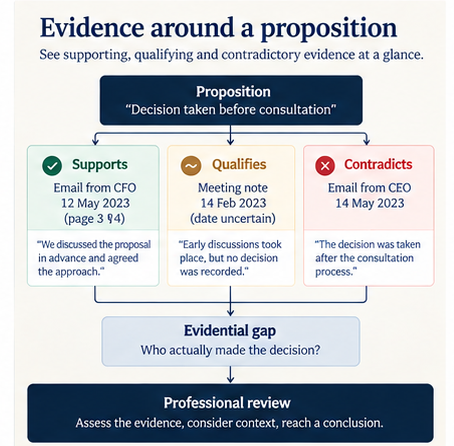
What cannot be found can sometimes be as important as what can, but absence must be expressed carefully.
“No approval email was identified in the material searched.”
is not the same proposition as:
“No approval email exists.”
The first describes an investigative result. The second asserts a fact that may not have been established. Likewise, not retrieved is not necessarily the same as not present in the matter, and neither necessarily means does not exist.
An evidential gap can therefore become a next action: obtain further documents, broaden the search, check attachments, examine another custodian or take further instructions.
Read the Insight on contradictory evidence and evidential gaps →
Many disputes turn on what particular individuals did, knew, received, authorised or understood. LegalRAG Pro can assist in examining people through their relationship with communications, chronology events, documents and issues.
The objective is not to automate a credibility judgement. It is to make the evidence relevant to the professional assessment easier to investigate.
As a matter develops, lawyers form provisional views about what happened and why. Those views need to be tested.
LegalRAG Pro can support an investigative workflow that asks not only “what evidence supports my theory?” but also “what evidence would make this theory wrong?”
A proposition may appear strong until an earlier document contradicts it, the chronology makes the alleged sequence impossible, the relevant person was not copied into the communication relied upon, the source is more tentative than the summary suggests, or an important evidential period remains unexplained.
AI-generated language can sound authoritative even when its evidential basis is weak. For an important proposition, the practitioner should be able to ask:
A citation is therefore the beginning of verification, not the end of it.
The usefulness of a matter-centred workspace becomes clearer when investigations cross traditional document boundaries.
This is different from asking a sequence of unrelated questions and then trying to reconstruct the reasoning from a chat history. The matter itself becomes the persistent unit of work.
What the documentary record actually contains and where it appears.
An extraction, comparison, observation or analytical proposition produced with machine assistance.
The conclusion the lawyer is prepared to adopt after reviewing the evidence, uncertainty and legal significance.
The professional assessment may accept the AI-assisted finding, reject it, qualify it, require further investigation, or reach a different conclusion entirely.
A contentious matter does not remain static. New disclosure may arrive. A witness statement may introduce a different account. An expert report may alter the significance of earlier material. An opponent's pleading may clarify what is genuinely disputed.
LegalRAG Pro is therefore designed around persistent matter knowledge rather than one-off document processing. The value is not simply producing an answer once; it is maintaining an organised evidential picture as the matter develops.
The working model can be summarised as:
Supporting and contradictory material, evidential gaps and uncertainty remain visible through that chain rather than being hidden by a fluent answer.
LegalRAG Pro does not turn source linkage into a guarantee of accuracy. It does not guarantee that every relevant document has been retrieved. It does not make an inference correct merely because a source is attached. It does not determine witness credibility or decide the legal merits of a dispute.
It does not replace a solicitor's duties to the client, opponent, court or tribunal, and it does not make the AI model the professional decision-maker. Legal professionals remain responsible for the evidence they rely upon, the conclusions they adopt and the work they submit.
Generic legal AI is often presented as:
Ask a question → receive an answer.
Contentious legal practice frequently demands a more rigorous chain:
Ask a question → identify the proposition → inspect the sources → reconstruct the chronology → identify the people involved → test supporting evidence → search for contradictory evidence → expose gaps and uncertainty → apply the issue → make the professional decision.
That is the problem LegalRAG Pro is designed around.
LegalRAG Pro is particularly relevant where the difficulty lies not simply in finding legal authorities but in understanding a substantial documentary record. That may include evidence-heavy employment disputes, commercial disputes, contractual claims, internal investigations and other contentious matters where documents, events, people and competing factual accounts need to be examined together.
Suitability depends on the particular workflow, matter and professional requirements. A practitioner walkthrough is designed to establish that fit before a controlled pilot is considered.
Related workflows
See how a documentary record moves through evidence review, chronology, issue analysis, contradictions, evidential gaps, source verification and professional review. No client matter needs to be selected before the walkthrough.